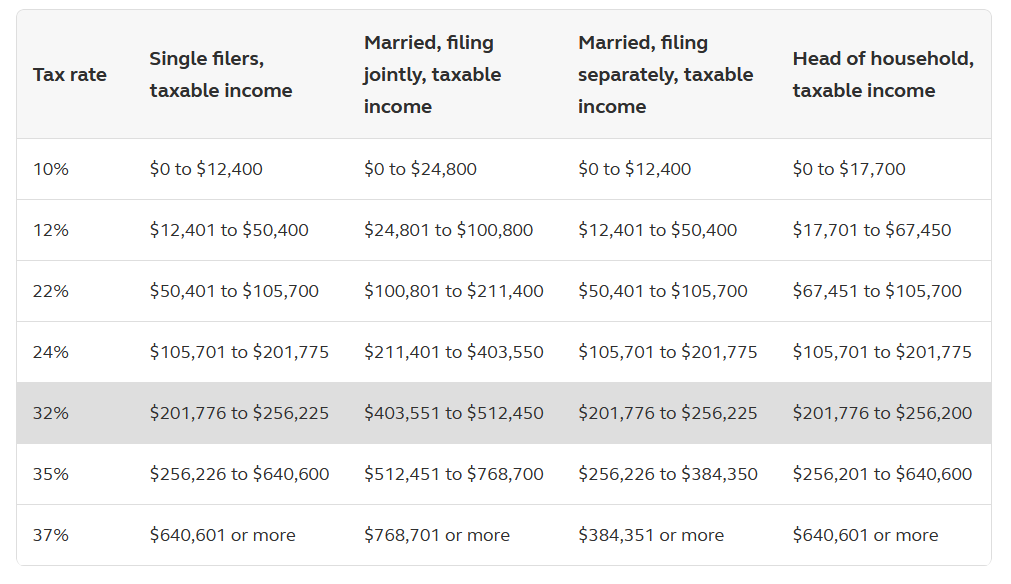
A key feature of the federal income tax structure is that it’s progressive: The more income you make, the more tax you theoretically pay. It’s also graduated; you pay higher tax rates on higher levels of income. Your federal tax bracket also depends on your filing status—married versus single, for example. There are seven federal tax brackets, and they are typically adjusted annually for inflation.
The 2026 standard deduction will rise to $16,100 for single filers and married filing separately, $32,200 for married filing jointly, and $24,150 for heads of household filers.
Other key adjustments for tax year 2026 include:
Flexible Spending Account (FSA) contribution limit is $3,400, and maximum carryover amount is $680.
Health Spending Account (HSA) contribution limit is $4,400 for self-only and $8,750 for family.
Alternative Minimum Tax (AMT) exemption amount is $90,100 ($140,200 for married filing jointly) and begins to phase out at $500,000 ($1,000,000 for married filing jointly).
Earned Income Tax Credit (EITC) maximum amount is $8,231.
Qualified Transportation Fringe amount is $340 per month.
Foreign earned income exclusion is $132,900.
Estate tax exclusion amount is $15,000,000.
The gift tax exclusion is $19,000 (no change).
The 401(k) contribution limit is $24,500 for employee contributions. Catch-up contribution limit for age 50 or over is $8,000.